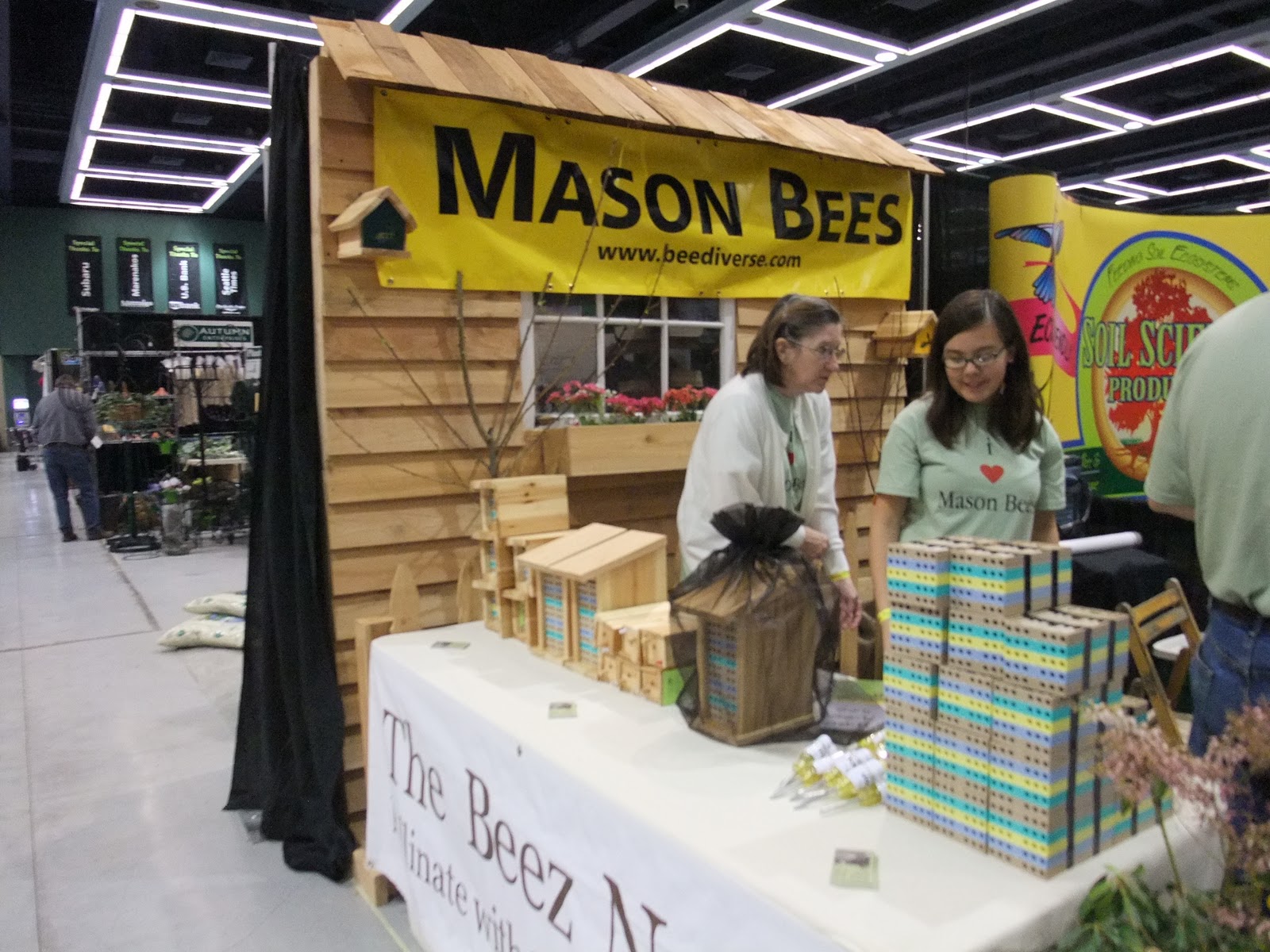
| Here is Jim Tunnel(with cap), owner of Beez Neez explaining mason bees to 3 customers. |
This blog is about cool things people tell me about, the things I see and photo-ops during my travels. My interest is related to bees and pollination, in particular mason bees and their management. Search a subject by using the search bar below.
Total Pageviews
Search This Blog
Wednesday, February 23, 2011
Where can I find Beediverse Products at the Flower and Garden show in Seattle?
Tuesday, February 22, 2011
Setting out cocoons using a Royal, Lodge or Chalet
The reason for setting out cocoons within the protection of a house that shelters nesting tunnels, is to provide the cocoons, and the mason bees inside, a place that is protected from predators like mice, protected from the sun and protected from rain and snow.
It depends on the design of the house whether cocoons can simply be set within the house, like underneath the roof of the Highrise or whether space needs to be created for the vial like in the Starter Cottage.
![]() |
| Royal house with predator guard |
![]() |
| Temporarily remove predator guard from the front of the Royal house, and set vial on its side, with tab removed, underneath peaked roof. Replace predator guard. |
The Royal house is similar to the Highrise. Simply remove predator guard, and set vial on its side underneath the peaked roof.
If you have a Lodge- without the predator guard, or the Chalet with a predator guard, space needs to be created for the vial containing cocoons. Remove one set of trays, insert vial above trays and replace vial with tray when all bees have emerged.
![]() |
| Lodge without predator guard. |
![]() |
| Chalet with predator guard. |
Setting out mason bee cocoons in a Beediverse Starter Cottage
![]() |
| If you have a Starter Cottage with cardboard tubes it is best to set the vial of cocoons inside the cottage amongst the nesting tubes. |
![]() |
| Temporarily remove front door to access cardboard tubes. |
![]() |
| Remove a few cardboard tube to make room for one vial containing mason bee cocoons. Remove red tab covering the exit hole of the vial, and place vial amongst tubes. |
Saturday, February 19, 2011
Setting out mason bee cocoons in a Beediverse Highrise
![]() |
| Retail stores sell Beediverse mason bee cocoons in snap-cap vials. Cocoons were harvested from nesting tunnels and cleaned. |
![]() |
| Loose cocoons harvested from nesting tunnels can also be placed underneath the roof of the Highrise-"the attic" |
![]() |
| Move cocoons towards the back. of the Highrise so they dont roll out the exit gap. |
![]() |
| Drop roof over attic in readiness for spring. |
Friday, February 18, 2011
Solid research blooms into bee business-About Beediverse- Small business
Click into the link below for a writeup about my business Beediverse.
http://www.bcjobsandeconomy.gov.bc.ca/2010/10/solid-research-career-blooms-into-bee-business/
Sunday, February 13, 2011
Emergence box and nests
Dave uses stacked pieces of routered wood as nesting tunnels. The emergence box removes the problem of predation during emergence. Photo credits Dave M. Port Alberni.
| Dave M.'s emergence box with nests on either side. Emerged males are clustered on the outside of the emergence box waiting for females to emerge. |
Dave uses stacked pieces of routered wood as nesting tunnels. The emergence box removes the problem of predation during emergence. Photo credits Dave M. Port Alberni.
Mason bees on Apple flower
A mason bee on an apple flower. A great pollinator of spring blossoms
when inclement weather is a common occurrance.
Photo credit- Dave M. Port Alberni, BC.
Honey bee and Mason bee on Dandelion Flower
This is one of my favorite flowers! Dandelions are a welcome color in the spring and they are a great source of both nectar and pollen for bees and other insects.
Most gardeners believe dandelion flowers are a nuisance weed and therefore it has to be removed from their green lawn.
If a gardener provides lots of flowers, more bees are in the garden and it generally means better pollination for fruit trees.
| This honey bee (left hand side) and mason bee are too busy feeding on a dandelion flower to notice the photographer Dave M. Port Alberni, BC. |
Saturday, February 12, 2011
Bumble bees in bird house
Kathy- Langley, BC sent me these photos of a bumble bees nesting in a bird house last spring.
This is not an uncommon occurrance. Bumble bees will nest in the ground, in a wall, in a bird house or other structure that will keep the weather out. Bumble bees nest within insulation, grass or other similar materials.
Birds bring nesting materials like moss and grasses into their bird house and leave after their young have hatched.
This is not an uncommon occurrance. Bumble bees will nest in the ground, in a wall, in a bird house or other structure that will keep the weather out. Bumble bees nest within insulation, grass or other similar materials.
Birds bring nesting materials like moss and grasses into their bird house and leave after their young have hatched.
"When you see them up close they have an incredible amount of pollen on their back legs. The opening into the bird house is 1 1/4" so you can see how huge they are."
Underneath the moss is a bumble bee colony. One bumble bee guard is walking on the surface of the colony.
| This is a guard- watching out for predators. |
| Bumble bee on the left is cooling the colony with its wings. The bumble bee on the right seems to be ready to go and gather more pollen and nectar for the young bees. |
| Coming in for landing. |
| Resting after a long flight. |
| Making room for a larger colony by removing excess moss material. |
Wednesday, February 9, 2011
Setting out summer mason bee cocoons in a release box
In the fall, when you find summer mason bee cocoons inside your nesting tunnels, the simplest is to clean out the other nesting tunnels and setting the nesting tray back, with the summer mason bee cocoons, in their wooden shelter ready for next spring.
An alternative is to gently remove cocoons with a scoop (these cocoons are more fragile then the relatively sturdy mason bee cocoons) and lay them into a emergence box like the one Dave M. from Port Alberni made or into the Beediverse Emergence Shelter (www.Beediverse.com).
By removing these cocoons from their nesting tunnel, you are freeing up valuable nesting space for other nesting bees in spring and summer.
| Summer mason bees removed from their Quicklock-Corn nesting tunnels. This bee uses masticated leaf material as partition material. |
| Summer solitary bees in a wooden nesting tray. |
| Beediverse Emergence Shelter |
| Emergence nesting boxes made by Dave M. of Port Alberni BC. |
An alternative is to gently remove cocoons with a scoop (these cocoons are more fragile then the relatively sturdy mason bee cocoons) and lay them into a emergence box like the one Dave M. from Port Alberni made or into the Beediverse Emergence Shelter (www.Beediverse.com).
By removing these cocoons from their nesting tunnel, you are freeing up valuable nesting space for other nesting bees in spring and summer.
| Summer mason bee cocoons placed into a Emergence/Release box, after removal from nesting trays. |
Tuesday, February 8, 2011
Nest Placement-East facing
Quite a few new mason bee enthusiasts have asked me about nest location.
The best location for nests optimally includes the following:
1) East facing-bees can warm up early in the morning
2) Sunny-warmth provides adult mason bees energy to fly and provides warmth for larvae to eat.
3) Underneath over hang- protects nest and bees from getting wet.
If you don't have all three factors at any one location, you may have to make a choice.
You may want to try nests at different locations. This will tell you which is the best location for the bees.
For more detailed information see my book "Pollination with Mason Bees" pages 31, 49-50.
The best location for nests optimally includes the following:
1) East facing-bees can warm up early in the morning
2) Sunny-warmth provides adult mason bees energy to fly and provides warmth for larvae to eat.
3) Underneath over hang- protects nest and bees from getting wet.
If you don't have all three factors at any one location, you may have to make a choice.
You may want to try nests at different locations. This will tell you which is the best location for the bees.
For more detailed information see my book "Pollination with Mason Bees" pages 31, 49-50.
Friday, February 4, 2011
Unsuccessful development of young mason bees
This nesting tray contains 5 nesting tunnels. The upper nesting tunnel contains cocoons with a mud partition between each cocoon. The mud plug at the left hand side of the nesting tray indicates the entrance /exit. The larger or female cocoons are at the back of the tunnel (RHS). Note in the next two nesting tunnels, there are quite a number of compartments, not with a cocoon, but with a pollen lump.
The presence of a pollen lump means that the bee larvae died and did not continue its development into an adult bee. This can be caused by disease, but can also be caused by cool weather. Young bees need warmth to feed. A two week spell of cold weather usually means the demise of these bees. Unfortunately in this case, the pollen lumps were at the far end of the tunnel and these are the female bees.
This year, many people were not able to produce many mason bee cocoons. I am sure the weather played a big part in this story.
Harvesting cocoons-with scoop and bucket
| Scoop tool |
Scoops are modified screwdrivers and are a boon to harvesting cocoons.
The angle (more like a sine curve) of the scoop ensures that the tip of the scoop slides under each cocoon and lifts them out of each nesting tray. No other tool does it so easily. At the same time as removing cocoons, nesting tunnels are rid of the majority of mud and other debris. This make the scrubbing process a lot faster.
| Cocoons are scooped out of nesting trays straight into a large bucket filled with water. |
Scoop cocoons out of nesting trays over a large bucket filled with water. After about 30 minutes, the water has softened the dirt around cocoons and the dirt drops to the bottom of the bucket. This is the first step in cleaning cocoons.
Dave M. uses a sieve for the next step. Using a sieve, a soft stream of water is sprayed over cocoons held in a sieve. Water removes a lot of debris from cocoons.
Once cocoons are washed, and dried, cocoons can be candled
A bleach wash, drying, screening and candling are the final stages of cleaning cocoons.
| A soft stream of water washes a lot of debris from cocoons held in a sieve. This idea came from Dave M. from Port Alberni, BC |
Releasing cocoons for emergence by the 1000's
| Small and large release box with piano hinged lids |
| Small release box with simple lid. Plastic containers are good for interim storage, but predation dictates a more sturdy wooden box. |
When setting out cocoons in large numbers, safety from predation has to be a key consideration.
Rodents can chew through plastic and paper. Dave M.from Port Alberni, BC uses a box with a piano-hinged lid to hold cocoons.
When spring arrives, mason bees emerge from the box ready to start pollinating.
The small box easily holds 2-300 cocoons. The larger box holds about 1000 cocoons.
It is best not to layer cocoons more than 1-2 deep. More than 1-2 layers of cocoons make it more likely that newly emerged bees pick up the rare mite from cocoons as the bee exits from the box.
Wednesday, February 2, 2011
Blog interest in North America, S. America, Europe, Asia, Eastern Europe and Russia.
Since the beginning of this blog (Dec 12th of 2010) people have visited from 19 countries. They have requested 1876 Page views. Below is a list of countries that have visited with the number of page views
USA 925
Canada 829
France 27
Malaysia 21
Turkey 18
Germany 11
United Kingdom 11
Australia 6
India 4
Slovakia 3
Israel, Denmark, India, Romania, Russia, Bulgaria, Brazil, Finland and Greece ( less than 3)
I find this interest quite fascinating. I know there are Osmia species in Europe, Asia, and North America, but I am not sure if Osmia species exist in South America. Osmia species do not exist in Australia. If you have a story or questions please let me know.
USA 925
Canada 829
France 27
Malaysia 21
Turkey 18
Germany 11
United Kingdom 11
Australia 6
India 4
Slovakia 3
Israel, Denmark, India, Romania, Russia, Bulgaria, Brazil, Finland and Greece ( less than 3)
I find this interest quite fascinating. I know there are Osmia species in Europe, Asia, and North America, but I am not sure if Osmia species exist in South America. Osmia species do not exist in Australia. If you have a story or questions please let me know.
Friday, January 28, 2011
Wasp predators found in Escape/Emergence boxes
![]() |
| Female wasps overwintering in an escape box (emergence box). If left inside box, wasps would eat bees as bees emerge from their cocoons. |
Hi Margriet: Look what I had waiting for me when I went to clean out the escape boxes from last year.
Dave M.Port Alberni, BC Canada
Mason bees use an umbrella as a nest site!
Hi Margriet: Here's a couple of pics I took today. The umbrella had been hanging on the back porch since spring. Nothing is safe around here. I got 6 cocoons and all are good. (4 females, 2 males). Dave M. Port Alberni, BC Canada
Thursday, January 27, 2011
Mason bees use a two foot long nesting tunnel.
![]() |
| Two feet long tunnel filled up to the 19 inch mark! |
![]() |
| A long nesting tunnel for a mason bee |
Hi Margriet, Well they have gone and done it again. You know that 8ft long escape box (emergence box or shelter), well I was cleaning it up for this season and noticed one of the escape runners looked plugged so I decided to take it apart to clean it. This is what I found. What do you think? Dave M. from Port Alberni, Vancouver Island, British Columbia.
I have not seen this before, but I am not surprised. As in your photos (see recent blogs), mason bees will nest in any type of 'cavity' (umbrella for example)! Thank you for sending the photos. Margriet
Mason bees in Turkey?
Peter B. from Ankara, Turkey emailed me the following question:
"Your fascinating website was sent to me by Chris K. I have looked at it plus several others. I am a beginner, but would like to try raising some mason bees as a hobby.
Yes, the species found in Turkey are different to the ones found on the North American continent, although their lifecycles would be similar to the ones found in NA. If the early spring mason bee exist in Turkey, it would be Osmia cornuta. The 7.5 mm or 8mm would be a good hole diameter to use for your nests.
If you are interested in seeing what solitary bee species exist in the area, make 2 or 3 different nest diameters. Local gardens with flowering plants would provide bees with pollen and nectar for themselves and their offspring. The nesting hole diameter I would recommend are: 3mm 5mm and 7.5mm. This gives you a good range of nesting tunnel sizes. Make nests by routering flat pieces of wood. These pieces are stacked and allow nests to be opened up in the fall. This makes it all the more interesting than just seeing the plug at the end of the nesting tunnel. Good luck, and let us know what you find.
"Your fascinating website was sent to me by Chris K. I have looked at it plus several others. I am a beginner, but would like to try raising some mason bees as a hobby.
I am from Vancouver, but living most of the last 10 years in Ankara, Turkey. I would like to try manufacturing a house for mason bees here in Ankara. A few quick questions for you:
1. Ankara is a big city (5,000,000) and at almost 1000 m elevation. We are some distance away from the downtown, there are some large city parks near us, but we are still in the city. Do you think there are any mason bees that we could attract here in Ankara?
2. I understand that the species is different for the mason bees here. For the house, is 8 mm diameter OK, or do they require a larger or small diameter hole? Is there anything else that would be much different from the North American mason bees in terms of housing or rearing requirements?
Thanks in advance, Regards, Peter B."
Yes, the species found in Turkey are different to the ones found on the North American continent, although their lifecycles would be similar to the ones found in NA. If the early spring mason bee exist in Turkey, it would be Osmia cornuta. The 7.5 mm or 8mm would be a good hole diameter to use for your nests.
If you are interested in seeing what solitary bee species exist in the area, make 2 or 3 different nest diameters. Local gardens with flowering plants would provide bees with pollen and nectar for themselves and their offspring. The nesting hole diameter I would recommend are: 3mm 5mm and 7.5mm. This gives you a good range of nesting tunnel sizes. Make nests by routering flat pieces of wood. These pieces are stacked and allow nests to be opened up in the fall. This makes it all the more interesting than just seeing the plug at the end of the nesting tunnel. Good luck, and let us know what you find.
Friday, January 21, 2011
Yurt 2010 -Cherry and Apple Blossoms
A beautiful cherry tree in full bloom. Something to look forward to!
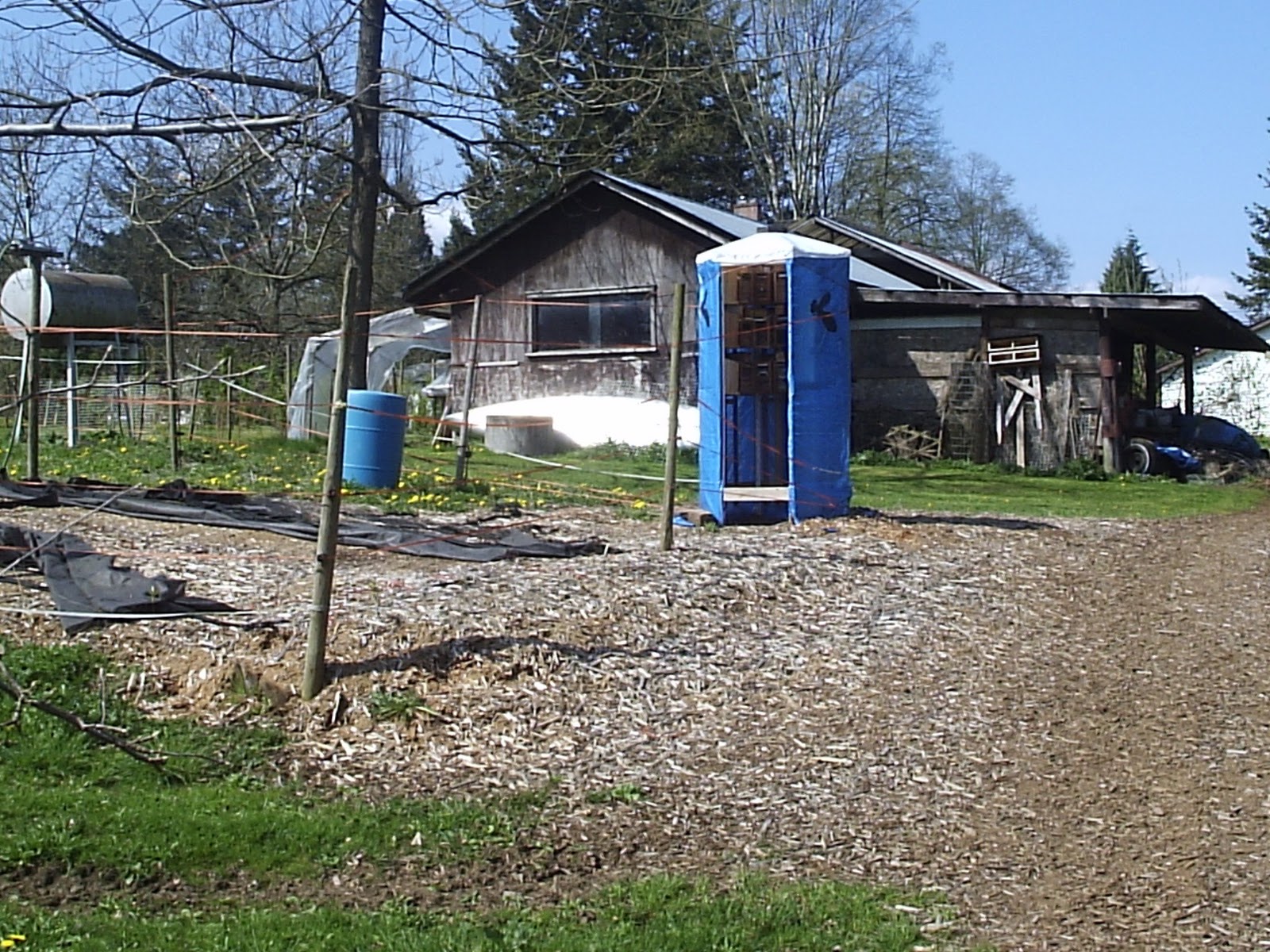
I have one of the yurts on this property. The neighbours came over and asked the owner of the property what that funny blue structure was in his yard. Not even the bees on the wall gave them a clue that this was our newest yurt! The bees love it. I love it. No worries about wind or rain. Lots of warmth inside the yurt to keep the larva warm during the day.
| The Yurt was placed in a sunny spot away from trees or buildings that might throw a shadow on it. |
| Apple trees in full bloom with yurt in the centre of the picture, behind the trees. |
Subscribe to:
Posts (Atom)