Monday, September 26, 2011
More mason bee Utube videos uploaded today.
I have uploaded a few more videos on Youtube today. Three of my earlier uploads were without a voice. This was corrected today. I created these video clip to answer questions about mason bees. One of the most common questions is about how to set out mason bees. The video clip shows how to set out a container of cocoons into the nest whether there are small or large quantities of cocons. If you have any suggestions about a topic for a video clip, let me know.


Monday, September 19, 2011
Utube videos by Beediverse
I have added two new video clips onto U-tube. These describe what size mason bee homes you can start off with when you have a small garden or a small orchard. The u-tube icons are on the top right hand corner of this blog.
Osmia californica- New Bee Product
This little mason bee Osmia californica, emerges soon after the early spring mason bee Osmia lignaria. We have supplies of Osmia californica available for our customers Click here for ordering your mason bees.
This little bee uses smaller nesting holes and has chewed leaf material as its nest plug. It will double the pollination season for your garden. Each bee nests and pollinates for about a month.Click here for more details about Osmia Californica
This little bee uses smaller nesting holes and has chewed leaf material as its nest plug. It will double the pollination season for your garden. Each bee nests and pollinates for about a month.Click here for more details about Osmia Californica
Blogging and ideas from Rick Spence
I saw a very interesting article in the National Post today. Rick Spence writes about blogs and what makes a good blog. He writes that blogging was in its heyday 5 years ago and wanders if blogging has lost its 'mojo'. He does not think so. He writes that it is a great way of communicating with people who are interested in a company's products and expertise. Rick includes a lot of ideas such as: writing on favourate topics, insider stories about products, stories about the industry, product development, product reviews, customer success stories, '...current issues rocking the industry...'. A lot of bloggers have given up because it is hard work. I agree that it is hard work, but feedback and ideas from people is always great. Keep the comments coming and let us here about your success stories and ideas.
Link to National post article "-Yes-a-blog
Link to National post article "-Yes-a-blog
Monday, September 5, 2011
Viewing Box for Mason Bees
Because of customer demand we will have Viewing boxes/Observation boxes available this upcoming season. This is a great teaching tool.
 |
| Viewing box closed and open showing the nesting tray. |
 |
| Viewing box with open lid showing nesting tray and cotton cover. |
 |
| Open viewing box showing cotton cover and entrance hole to box. |
 |
| Open viewing box showing wooden nesting tray. |
Thursday, September 1, 2011
Saltspring Island Apple Festival-a day trip
It could be a day trip or even a weekend away.
I thought a few more details about the Apple Festival would be in order. It is such a fun day. And what an experience.
When you come to Saltspring Island, come either the day before or the early ferry from Victoria. The first stop is Fulford Hall. It is a grand old hall. Perfect for such an occasion. Hundreds of apple varieties will be on display. If you have an apple variety and you wish to know what it is- check out all the varieties on display. It is a bit dizzying, but stay focused. Then there is a section where you can buy a piece of apple pie. There is nothing new about apple pies, but these are very special. Nowhere else can you buy a piece of apple pie made with a known apple variety! Of course you will have to try 2 or 3 pieces! Then there are various booths with things to eat or things for your home. We will be at our Beediverse table and I will have a number of mason bee houses and other items such as Scoops available for sale. Come to our table and say Hello. Bring your questions.
After you have done the circuit of the Hall it is time to experience Saltspring Island. You are given a map and locations where you can sample Saltspring Island apples and other goodies. See you there.
I thought a few more details about the Apple Festival would be in order. It is such a fun day. And what an experience.
When you come to Saltspring Island, come either the day before or the early ferry from Victoria. The first stop is Fulford Hall. It is a grand old hall. Perfect for such an occasion. Hundreds of apple varieties will be on display. If you have an apple variety and you wish to know what it is- check out all the varieties on display. It is a bit dizzying, but stay focused. Then there is a section where you can buy a piece of apple pie. There is nothing new about apple pies, but these are very special. Nowhere else can you buy a piece of apple pie made with a known apple variety! Of course you will have to try 2 or 3 pieces! Then there are various booths with things to eat or things for your home. We will be at our Beediverse table and I will have a number of mason bee houses and other items such as Scoops available for sale. Come to our table and say Hello. Bring your questions.
After you have done the circuit of the Hall it is time to experience Saltspring Island. You are given a map and locations where you can sample Saltspring Island apples and other goodies. See you there.
Wednesday, August 31, 2011
Beediverse at the Saltspring Island Annual Apple Festival October 2, 2011
Beediverse will be at the Saltspring Apple Festival with Beediverse products and show and tell items.
Here is the information from Harry Burton, the organizer.
"We'd like to let you know about a very special little Apple Festival that happens every fall on Salt Spring Island. It will give you an "apple experience" like you have never imagined. It is purposely kept non-commercial and farm related. Where else can you
-find over 350 varieties of apples, all grown organically,-connect with all the farms that grow those apples,-taste about 100 varieties of apples at just one of the farms,-see a labeled display of over 300 apple varieties.-taste labeled apple pies baked with 15 apple varieties. The Pie Ladies baked about 150 apple pies in 2010.-experience an apple history going back to 1860-get to enjoy a tremendous varieties of lunches right at the farms - a culinary adventure.-taste fresh apple juice made from specific apple varieties.-experience over 20 varieties of red flesh apples. That is why we call Salt Spring "APPLE HEAVEN." Sunday, OCT 2, 2011
See past highlights at http://www.appleluscious.com/
Vladimir from Calgary discusses the Belle de Boskoop.

Fallen fruit tree uprighted
Even though we have had an extended cold spring, apple trees are loaded and there have been several reports of trees falling over. Here is a video clip of uprighting a fallen tree.
Up-righting a fallen apple tree
Up-righting a fallen apple tree
Monday, August 29, 2011
Colourful flowers feed an array of bumble bees.
Today I stopped by a Oliver Woods Recreation centre in Nanaimo (BC Canada). It is a beautiful facility.
What really took my fancy were the beautiful raised flowerbeds at the entrance to the building. Very welcoming. The colours were stunning. On closer inspection, bumble bees liked this array of flowers too.
 At the end of summer bumble bee colonies stop growing and the colony begins to produce queens and males. Queens mate with the males or drones and then hibernate over the winter until the following spring. It is important to have well fed drones so they can fly and mate with the queens. Flowers that provide nectar for bumble bees are a must. The flowers in these photos are great nectar producers as the presence of these bumble bees indicate.
Most of these bumble bees are males. Males usually have yellow heads.

What really took my fancy were the beautiful raised flowerbeds at the entrance to the building. Very welcoming. The colours were stunning. On closer inspection, bumble bees liked this array of flowers too.
 At the end of summer bumble bee colonies stop growing and the colony begins to produce queens and males. Queens mate with the males or drones and then hibernate over the winter until the following spring. It is important to have well fed drones so they can fly and mate with the queens. Flowers that provide nectar for bumble bees are a must. The flowers in these photos are great nectar producers as the presence of these bumble bees indicate.
Most of these bumble bees are males. Males usually have yellow heads.


 |
| This bumble bee is Bombus vosnechenskii |


Grow flowers and they will come.
Sunday, August 28, 2011
Blackberries- great eating or a pest?
In July/August blackberries bloom and flowers provide great food for bees. Blackberry flowers are great providers for bees. They provide both nectar and pollen to bees. For us, Blackberries are great eating and make tasty jams and jellies.
But watch out! Blackberries will easily take over and are tough to get rid of because of their extensive root system.
More on Himalayan blackberry
 |
| Blackberries- ready to eat |
 |
| If the hot weather holds, I will be picking more blackberries soon. |
A farming experience!
We baby sat a home with some farm animals last week. An easy task, I'd say.
I was warned a bout the ram.
A nice looking fellow.
I was warned not to go into the pen, because I would very quickly be on my butt. He looked pretty calm to me.
This morning, I gave him fresh water, through the fence, but the bowl for his oats were a little distance from the fence- but close to the gate. Protected by a fence board from any onslaughts, I held the board at his head level and against my legs. I meekly entered the gate. I had not stepped into the pen before he head butted the board, cracked the board and off course I made my escape. Phew, that was close!
I have re-named him "Stew"
You may be wondering what this story has to do with mason bees. Since all the mason bees are in their cocoons and are awaiting fall cleaning, I am enjoyed a few days away on a farm on Vancouver Island.
I was warned a bout the ram.
 |
| I don't know this fellow's name.... |
A nice looking fellow.
I was warned not to go into the pen, because I would very quickly be on my butt. He looked pretty calm to me.
This morning, I gave him fresh water, through the fence, but the bowl for his oats were a little distance from the fence- but close to the gate. Protected by a fence board from any onslaughts, I held the board at his head level and against my legs. I meekly entered the gate. I had not stepped into the pen before he head butted the board, cracked the board and off course I made my escape. Phew, that was close!
I have re-named him "Stew"
You may be wondering what this story has to do with mason bees. Since all the mason bees are in their cocoons and are awaiting fall cleaning, I am enjoyed a few days away on a farm on Vancouver Island.
Wild fruit and pollination
On Vancouver Island (British Columbia, Canada) there are all kinds of wild and native fruit that are edible.
When I see fruit on native trees and shrubs, I straight away think that when these plants were in bloom, there were lots of bees in the area. It is always fun for me to have a closer look.
These photos were taken under a Douglas fir/Pine canopy. Filtered sunlight and sunlight available along trails and roads allows these plants to grow profusely.
When I see fruit on native trees and shrubs, I straight away think that when these plants were in bloom, there were lots of bees in the area. It is always fun for me to have a closer look.
These photos were taken under a Douglas fir/Pine canopy. Filtered sunlight and sunlight available along trails and roads allows these plants to grow profusely.
 |
| Salal berries. Ready to eat! |
 |
| Some of these Salal berries are shriveling up from the drying sun. |
 |
| Red Huckelberries- few, but great tangy morsels for eating |
 |
| Thimble berry. A real treat! |
 |
| A profuse number of Salal berries. Ready for eating. |
 |
| Thimble berry flowers are about as big as a bumble bee. If a smaller bee visits a Thimbleberry flower and if this smaller bee does not move around the flower, only part of the flower will be pollinated- as in this flower. 95 percent of the flower in this photo is pollinated, but a small strip was not pollinated (seen as a band of unpollinated ovaries). |
Saturday, August 27, 2011
Travelling beautiful British Columbia
 |
| Northern Arrow Lake,BC,Canada |

 |
| Ferry crossing of northern Arrow Lakes |

Have a great summer!
Natural patterns-trembling Aspen
We visited our family during the kid's summer holidays and on our return from Prince George the aspen trees caught my attention.
Between Prince George (northern British Columbia) and Quesnel, the majority of aspen trees looked grey. During the summer and early autumn, the foliage of aspen trees is a deep green, not quite as dark as the evergreen trees in the area. The trees looked oddly ghostly, not normal at all. I first thought it might be a mildew infestation. Then I thought, it might be possible that an early frost had hit the trees. But this did not seem right because a frost would hit the top branches and not necessary the inner branches.
I finally stopped to have a closer look. I soon realized it was an insect infestation. Insect larvae had eaten through the very thin layers of a leaf and exited at the far end of the leaf. The reason why leaves appeared grey was because the green chlorophyll layer had been eaten by the insect larvae. The patterns created by these insects were beautiful.
A further look at the Aspen leaf miner, see link at the end of this article.
In nature, you never know what there is to see.
Aspen infestation in the news.
Between Prince George (northern British Columbia) and Quesnel, the majority of aspen trees looked grey. During the summer and early autumn, the foliage of aspen trees is a deep green, not quite as dark as the evergreen trees in the area. The trees looked oddly ghostly, not normal at all. I first thought it might be a mildew infestation. Then I thought, it might be possible that an early frost had hit the trees. But this did not seem right because a frost would hit the top branches and not necessary the inner branches.
I finally stopped to have a closer look. I soon realized it was an insect infestation. Insect larvae had eaten through the very thin layers of a leaf and exited at the far end of the leaf. The reason why leaves appeared grey was because the green chlorophyll layer had been eaten by the insect larvae. The patterns created by these insects were beautiful.
A further look at the Aspen leaf miner, see link at the end of this article.
 |
| Beautiful patterns in a aspen leaf. |
 |
| A pathway of an insect |
 |
| Ghostly looking trembling aspen |
 |
| Along the Prince George Highway BC grey aspen were the norm. |
 |
| A grey forest! |
 |
| Grey aspen in the foreground. Green fir in the background. |
 |
| During the summer months, aspen are similar in colour to other green plants below the aspen. The grey was startling against a backdrop of green fir and close to pale green herbaceous plants. |
 |
| The whole aspen tree canopy was consumed by these insects. |
Aspen infestation in the news.
Wednesday, August 17, 2011
Protect your mason bees from the tiny parasitic wasps
This is the time when parasitic wasps can produce another generation every week. During the summer months, when temperatures are higher than in spring and fall, these pesky little critters come out of the nest and search for new mason bee cocoons to parasitize. I don't know how, but these tiny adult wasps can make a tiny pin hole in the tube and crawl out and parasitize more bees.
Every July, when most bee eggs have turned into adult bees inside their cocoons, I gather all nests, set them under a veranda- where the ambient temperature is still warm. I place two Highrises per net-bag (see wasp proof bags on my web site beediverse.com). They sit stacked against the wall of my home until the end of September when harvesting takes place.
I find that net bags are successful and keep out wasp parasites. Percent parasitism is usually not more than 5%. If you have had trouble with these parasites, you will be pleasantly surprised with the outcome.
Every July, when most bee eggs have turned into adult bees inside their cocoons, I gather all nests, set them under a veranda- where the ambient temperature is still warm. I place two Highrises per net-bag (see wasp proof bags on my web site beediverse.com). They sit stacked against the wall of my home until the end of September when harvesting takes place.
I find that net bags are successful and keep out wasp parasites. Percent parasitism is usually not more than 5%. If you have had trouble with these parasites, you will be pleasantly surprised with the outcome.
Saturday, August 6, 2011
Wild Honey bee colonies In Australia's Centre
 |
| Walking trails in the Center |
The Australian outback is an amazing world of contrast: red and black cliffs, dry desert landscape with water-filled gorges, prickly spiky plants with soft colourful flowers, beautiful birds and their loud calls. I was lucky enough to call Australia my home when I was a child and always look forward to going back, seeing my family and having another look at the land. This year, I spent quite a bit of my holidays in Australia's Center. I wanted to check out more of the land and walking is a great way of doing it. We bought our food and water from the town of Alice Spring and went walking along a number of different trails.
 |
| Depending on the light, cliffs are either red, burnt orange purple or varying co.lours in between. |
We saw quite a bit of wild life including kangaroos and lots of birds. There were very few insects around because night time temperatures were around freezing a lot of the nights. I was pleasantly surprised though when Matt showed me a honey bee colony. Matt told me he had seen them at this location before. It was about 30 feet up on a cliff. Honey bee comb attached to an open cliff would be a rare sight in Canada, but in Desert country it is the perfect place. There is very little rain to speak of so a colony does not need protection from the rain. Since it had rained recently, trees and shrubs were showing off their bloom. This of course means food for honey bees.
 |
| Honey bee colony on a cliff in the Center. |
 |
| Gum tree flowers with a foraging honey bee. |
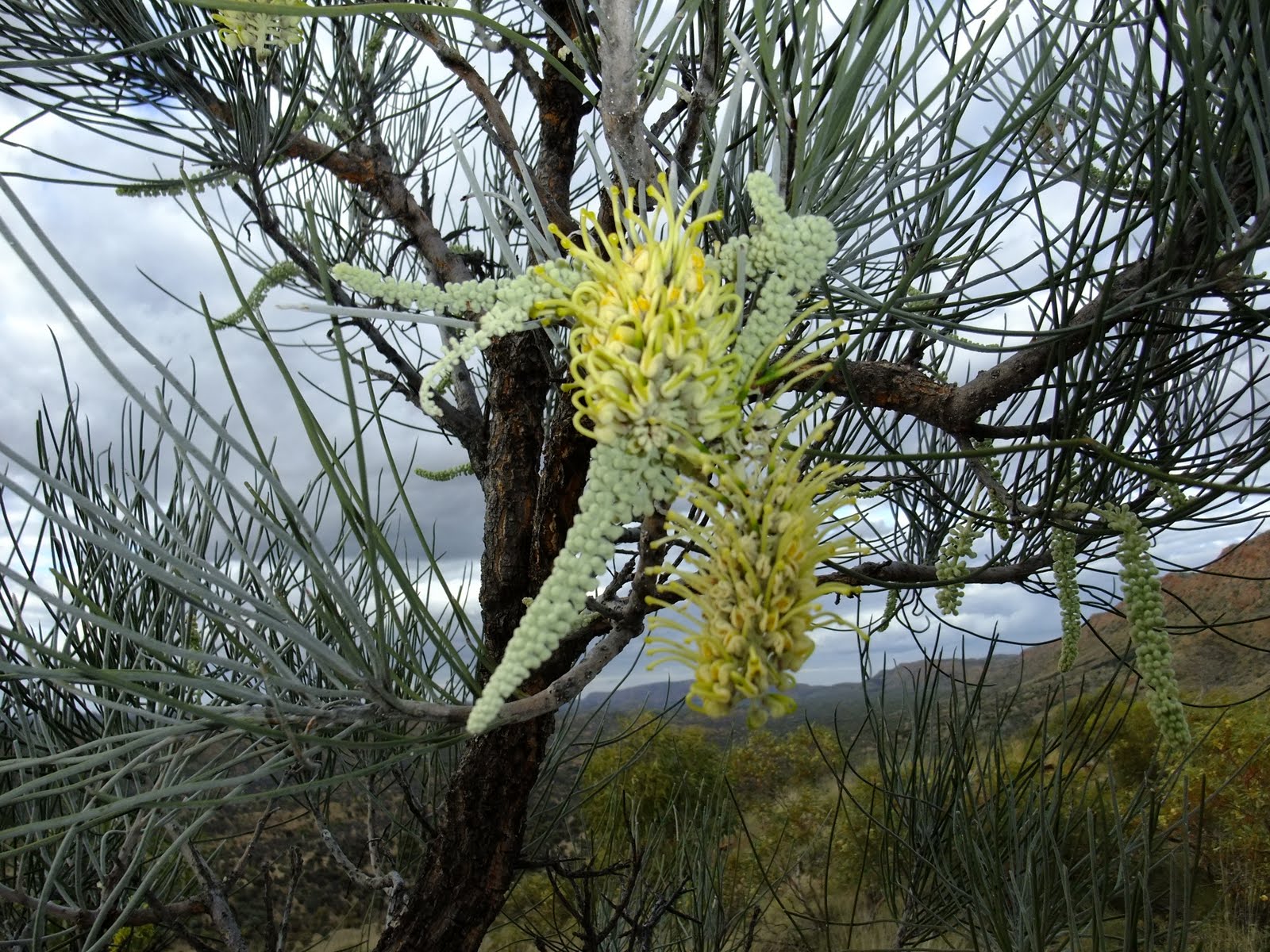 |
| Hakia flowers provide lots of nectar for birds called Honey-eaters |
 |
| River beds and cliffs provide great habitat for all kinds of wildlife including lizards, cliff dwelling birds and hawks. |
In the next little while, I will be adding a few more blogs of my trip. You can imagine the number of photos I took! Have a great summer!
Thursday, August 4, 2011
Youtube
I have added my YouTube videos under "VIDEO BAR" as a clickable icon above "ABOUT ME". Simply click on the video picture and watch bees at work.
In the video of bees at the nest, watch how bees mould mud to plug up their nest holes.
In the video with bees visiting flowers, look closely at bees taking up nectar from flowers.
In the video of bees at the nest, watch how bees mould mud to plug up their nest holes.
In the video with bees visiting flowers, look closely at bees taking up nectar from flowers.
Friday, July 15, 2011
Providing continuous bloom for bees -Joe S.
In the spring, Joe S. and I chatted about providing continuous bloom for bees in his garden. When one type of flower has finished blooming there should be other flowers just beginning to open and bloom. Continuous bloom is an important part of managing a continuous food supply for wild bees.
When I photographed his spring blooming flowers, he mentioned that the following bloom would provide food for his summer bees including summer mason bees.
Sedum
Budlea
Italian herbs
Catony aster
When I photographed his spring blooming flowers, he mentioned that the following bloom would provide food for his summer bees including summer mason bees.
Sedum
Budlea
Italian herbs
Catony aster
Monday, July 4, 2011
More bee attractive flowers, Quadra Island, BC Canada
 |
| Aquilegia/columbine |
 |
| I will ask the gardener the name of this plant. |
 |
| Strawberries |
 |
| Lupine |
 |
| ? |
 |
| Crane's bill- perrenial geranium |
 |
| Campanula |
 |
| Batchelor button |
 |
| Crane's bill |
 |
| Fenced vegetable garden. Deer, will eat anything, so plants have to be fenced in securely. |
 |
| Pyracantha |
 |
| Pyracantha |
 |
| Campanula |
Subscribe to:
Posts (Atom)