Total Pageviews

Search This Blog

Tuesday, January 31, 2012

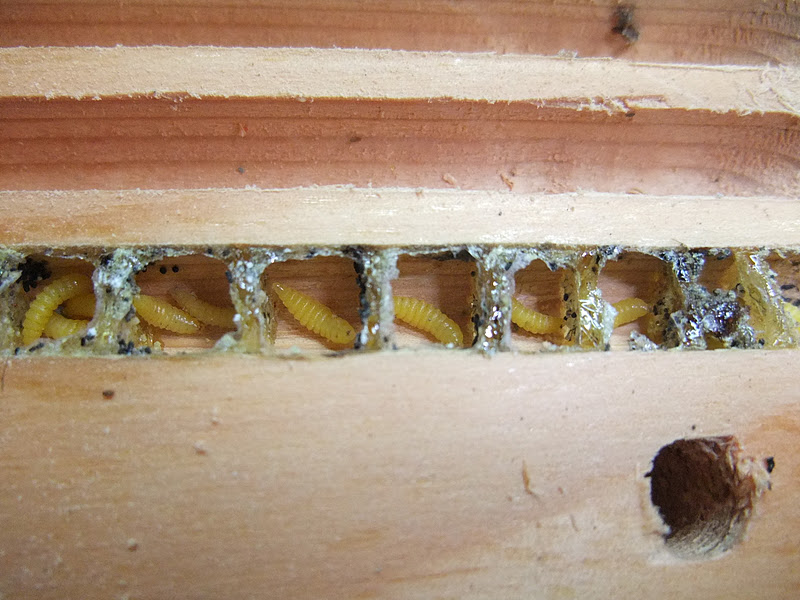
Inside the nest-pupae and wiry frass

Here is Frank's photo number 017 
"It shows a wooden tray infested with foreign larvae, plus at least four different-looking types of wiry frass.  Are they all from the same insect and  reflect differences in diet, or might they actually represent different organisms?"
The upper channel possibly contains the pupae of the houdini fly.  The lower channel has 3 chambers with wiry frass that probably belongs to the spider beetle.
Lovely photos Frank.  Sorry we could not be more clear on the ID of these insects.  Let me know if you have placed them in a petri dish to develop into full adult.

Inside the nest- many white pupae

Here is photo 011 by Frank M. 
Frank writes "011 shows just how abundant these foreign larvae were in some cases.  In this image, they are actually spilling out of the channels because the upper part of the channel was filled too. Notice also that at the right-hand side of the image there is a chamber filled with wiry frass that is different from the stuff in image 004."

These grubs, may well be the 'fruit fly' Joe S. took and I wrote about on Jan 7th 2011 in this blog.  Joe mentioned these fruit flies had red eyes.  A friend of Joe's searched the web and came up with "houdini fly"  Cacoxenup-inbagator flies.

If you still have these grubs, set them up in a moist warm environment such as a petri dish and see what comes out.  What an interesting project for a child who is interested in science.  The search continues.

Monday, January 30, 2012

Inside the nest- wiry frass

Frank M.  contacted me recently about his findings at his yearly mason bee workshop.  A most interesting series of photos- with permission.
"This photo shows some extraordinary wiry frass, even more wiry than the material that I showed you last year from the 2010 harvest.  Any ideas?  There is also some fluffy stuff in the same chamber and the one next to it, similar to the material in one of the images on one of your blogs."
This beautifully constructed chamber inside a routered piece of wood, has concave mud walls.  It normally contains one masn bee cocoon, but something has entered it.  The chamber contains frass- or insect fecal material.  According to Bosch and Kemp (2009)  wiry frass is likely produced by one of two insects found in masn bee nesting tunnels.  One is the cuckoo bee.  If there is a cocoon amongst the mass of frass- then it would be the cuckoo bee.  If there is no cocoon- it is most likely the spider beetle.  It is about 2-3mm long with 4 white patches on its back and long attennae.  Both insects eat and destroy the mason bee larvae and its food.  They both invade the chamber when it is pretty close to being sealed by the bee.

Sunday, January 29, 2012

Ground nesting Bees in a school yard

Ground nesting bees usually emerge in June when soil temperatures increase from the cooler spring temperatures.  These bees are often more than a foot down in the ground.  Usually one bee uses one entrance, but in some species a few bees use the same entrance, but different nesting tunnels.

This aggregation is in a school yard ( Burnaby, BC).  When Alie told me about it, she showed me the area adjacent to a small fence.  the kids came out for a show and tell, and they were fascinated.  Anyone know the type of bee?

The soil is quite hard in this area and when the sun shines, the ground is always in the sun.  if you look closely, you can see little mounds of earth deposited by the emerging bees.  The scale becomes a little clearer when you see the children's feet in the area.  When all the children were back in their class, I checked out to see the scope of the area.  It was quite large  (10 x 10 m or 30 x 30 feet). 

Thursday, January 26, 2012

Snowy Owls- Coastal BC

We have had some awesome visitors on the West coast of BC and in WA.  My friend Gary sent along these pictures and the photographer gave me his permission to place them on this blog.  Thank you Bob Nolan for sharing your awesome pictures.  Gary said that

"Those owls were there, apparently, because the lemming population in the north is unusually low, so they are foraging for whatever fish, rats or mice they can snag before continuing their winter flight to their southern habitat.   Let's hope they get enough to sustain themselves for the journey."

Late January

Ahhg... time flies when you are having fun!  I thought about the blog a lot over the past couple of weeks, but have had no chance to get it.  First a new flu bug got hold of me and that was no fun.  Soon after year-end  was a must.  But now things are moving along nicely and I have a bit more time for blogging.  I picked up some interesting stories and photos from friends over the last couple of weeks.  In the next bit, I will share them with you.  I hope you like them.  Margriet

Monday, January 2, 2012

Mason Bee home Kit- no nails- no glue!

Over the holidays, we have been busy assembling our new Mason Bee Home Kit.  It is a nifty product and will be a very popular item for children in schools and in the home.  Besides the pieces that make up the home, there is enough paper in the kit for making 20 nesting tubes.  This will get the child started.  If they decide to make more nesting tubes, newspaper or Kraft paper can be used to make more nesting tubes.  It will be fun to see how children will decorate their mason bee homes.  Please send in your photos of completed homes that are decorated and ready for the garden.   I am looking forward to seeing the art. 

Click on the link below to see the Kit.  Scroll to the last item in the Category


view the kit

Saturday, December 31, 2011

Oliebollen for the old and New Year.


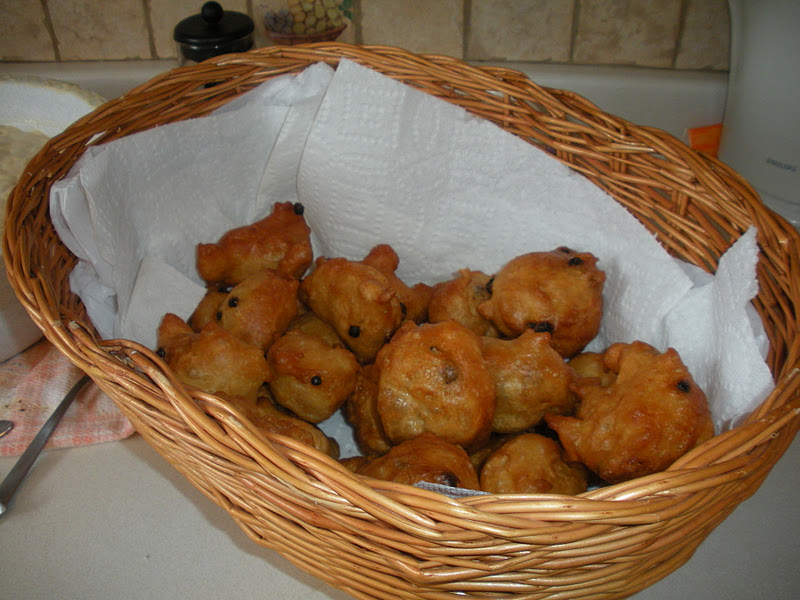
Here are the Oliebollen.  Very good indeed!

Wishing you all the best for the coming year!

Bringing in the New Year with Oliebollen

My Dutch neighbour Alie told me that she is going to make oliebollen. This is a Dutch tradition that I remember from my childhood.  It is a memorable way to say goodbye to the old and bring in the New Year.  Every year Alie invites me for a tasty treat of oliebollen, but I have never made them.  I am off to give her a hand and maybe taste a few morsels....

Web site news- Happy New Year!

Bonnie, my web guru and I figured out that we should and that we can have two categories of homes under mason bee homes.  This would be easier for folks. 

The two categories under Bee homes would be -Spring mason bee homes and Summer Mason bee homes.  Right now the different homes with their various nesting materials are grouped together.  This is a little overwhelming, I think. 

Spring nesting materials available on my web site are CORN Quicklock nesting trays, Ezy-harvest cardboard nesting tubes and Natural Phragmites Reeds.  We have two types of nesting material for the smaller summer mason bees.  Summer nesting materials available on Beediverse.com are the wooden routered trays and corrugated cardboard.

I will be doing this over the next few days.  I hope you will like the changes.

Happy New Year!


Thursday, December 29, 2011

Beediverse web site

I have been working on my Beediverse website and have some thoughts on organizing Beediverse products in a couple of additional categories.  Of course, there are always better ways of organizing items and of course writing about them. 

In the early days of Mason beekeeping as a gardener's hobby, it was important to have a product category for "Starting out " and "Learning about". 

Now Mason Bee keeping is at a different stage.  Gardeners who have the experience with spring mason bees, are keen to attract summer mason bees for exmple.

These categories could be expanded for example to explain the different nesting materials required for spring mason bees and summer mason bees.    A clear distinction between spring and summer mason bees is needed to make it easier for people to make a decision on what nesting material and or housing they need.  An explanation is needed that that Spring bees are larger and need larger nesting cavities and that summer mason bees are smaller and need smaller nesting tunnels.    This explanation plus placing spring and summer houses and spring and summer nesting material in different categories would be a good start.

Sunday, December 25, 2011

Ground nesting bees in a local school ground

A neighbour of mine reminded me of the local ground nesting bees at her school.  Some pictures were taken and we should be able to get them identified.

Friday, December 23, 2011

New Item-Mason Bee Home Kit

I am continuously on the lookout for items that might be of interest to mason bee enthusiasts. 

We have just added  a Mason Bee Home kit to our line of Beediverse products.
The neat thing is that it assembles without nails or glue!  It includes instructions on how to roll your own paper nesting tubes.  This is an awesome product.  Another big advantage to this home is that it ships flat.  Savings in shipping is significant.

Kit- Mason Bee Home
This is the perfect item for people who like to put things together.  A great school project!

Once assembled, the Bee home can be set out on an east facing wall, in a sunny location and under an overhang.  It houses 40 mason bees and is ready to pollinate your fruit trees.

The kit includes pre-cut wooden bee box, mounting nails, sand paper, pre-cut Kraft paper for 40 bee tubes, dowel for rolling bee tubes, and tape for taping bee tubes.

This home is big enough to fit a Quicklock nesting tray with 30 holes and with room to spare for additional nesting tubes or a release shelter.
Instructions include how to assemble the bee home and how to roll your own bee nesting tubes.

Thursday, December 22, 2011

Whistler- Christmas

We headed up to Whistler the other day.  An annual Christmas gathering of friends.  It was a lot of fun.  The drive along Howe sound, through Squamish and to Whistler is spectacular with the mountains in their winter coat.  Merry Christmas everyone!
On our way to Whistler, just out of Horshoe Bay

The road to Whistler goes along Howe Sound. 
The Tantalus Range is in the background


The spectacular scenery is accentuated with the curves in the road.


Mt Garibaldi above Squamish

A close up of the Tantalus Range in the setting sun

The last rays of sunlight on the Chief rock wall above Squamish.

A Christmas scene in Whistler

Whistler

Friday, December 16, 2011

Six Inch Petri dishes and How to use them.

Six inch diameter petri dishes are very handy to have when keeping mason bees, especially when storing cocoons.  Winter storage of cocoons containing live bees can be problematic since you need humidity and air.  Petri dishes allow both air and humidity to pass under the lid and over the lip and into and out of the pretri dish.  Tiny strips keep the lid off the base and thus allowing air to pass.  All this means that living things can be stored in petri dishes.  Another good feature of a petri dish is that organisms can crawl around inside the petri dish, be safe and not escape.

About 100-200 mason bee cocoons can be stored in each petridish.  Petri dish are stackable and can occupy very little space. 
Here are a few ways to use  6" petridishes:
1.  Store cleaned cocoons inside a refrigerator that is a manual de-frost fridge)
2.  Each petri dish can be labelled according to location and other information.
3.  Store suspect cocoons-I call these DUDS!
When candling, cocoons that do not contain a bee can be set aside and left refrigerated until spring.  In spring, the petri dish is left on the counter.  If any bees emerge they can be released.
4.  Store unknown organisms until emergence
5.  Petri dishes are stackable and occupy very little space.
Stack of petri dishes with cocoons inside a manual defrost fridge.
A thermometer is an important tool to make sure the temperature
is right for keeping cocoons under hibernating conditions. 
In late Jan temperature is lowered to between 2-4C or 35-39F

Always keep a container of water inside the fridge. 
This is an easy way to make sure that humidity is above 60%.

Label each petri dish.

In a manual defrost fridge, there is a freezer compartment
that will require defrosting each year.

In spring, the occasional male will emerge even
though temperatures are low.

For spring emergence, cocoons can be placed into Starter
cottages or Emergence Cottages.  These can be temporarily
stored in the fridge, until weather conditions are reasonable.

Store cocoons inside Petri dishes that may contain parasitic wasps. 
Place on kitchen counter in spring.  If any bees emerge
 they can be released.  Parasitic wasps can be destroyed by freezing .

Thursday, December 15, 2011

Discovery of new Sweat Bee Species

Researcher discovers 11 new sweat bee species, four in New York City area
Alfonso emailed me today and let me know about this interesting research.  He adds-

"I bet if we really surveyed what we had, we could come up with some incredible results of what's really out there. Alfonso"


Click here for the full story

Wednesday, December 14, 2011

Andrena colony update

Here is an update from researcher Mike

"We would very much appreciate if you could place a request on your blog. Coastal B.C. would be convenient, but we are willing to consider anything. We do have a colleague collecting stylopized Polistes in Eastern U.S.A.; that is where we found the large Colletes aggregation I referred to in my last email. Please don't hesitate to contact us if you think of anything."

Tuesday, December 13, 2011

Researcher is looking for Andrena bee ground nesting colonies

This researcher would like assistance with locating a ground nesting colony of Andrena bees.  (Stylopized bees are parasitized bees).  If you have seen any ground nesting bees, please respond to this web.  Your help is greatly appreciated.  I think he would like the locations to be in the Vancouver region of BC. 

Check out the two links below for beautiful photos of various bee species and stylopized bees.

Hello Dr. Margriet Dogterom,
This year I embarked on an project involving the signalling in Strepsipteran parasites of Polistes wasps. Next spring we would like to expand our research to Andrena bees. Ideally, we need to locate large aggregations to provide a ready supply of stylopized bees. We found one large aggregation that turned out to be Colletes, and another that is not very accessible (It's on a city boulevard).

Ideally we need to locate colonies before emergence next spring, as the stylopized bees emerge first. Would you happen to know the whereabouts of any Andrena bee aggregations? 
Thank you,
Mike


Photos of stylopized bees

Photos of mason bees and other bees

Sunday, November 27, 2011

Inside the nest: cocoons inside 'cotton fluff"

There have been half a dozen reports of cotton fluff inside the nesting tunnels.  Here is one I found myself.  Most of the fluff is just that, but two cocoon type structures were found in the center row.  If someone knows what this is please let us know.
A nesting tray with 6 routered channels containing mason bee cocoons,
and cotton type fluff in two of the channels.  

Here I have lifted some of the fluff out to show how it neatly fits into the channel.

Two cocoons were found inside this fluffy material.
You can see the end cap directly above where the cocoon is held in the photo.
 The end cap is made of several layers of mud and is thicker than the usual mason bee end cap.

For comparison, this appears like a spider web,
 which either contains young spiders or an adult spider.

Inside the nest- Resin bees

 When I find resin bees inside nesting tunnels, I remove any mason bee cocoons , remove mason bee debris out of tunnels with a tooth brush, close up the nest and set out side ready for next year.
Two delicately placed resin walls.  No bees were in these cells.

Resin bee pupae within compartments made of resin.


Last year's resin bees emerged during summer months
when resin softened up with the heat.